 Olivia Jayne
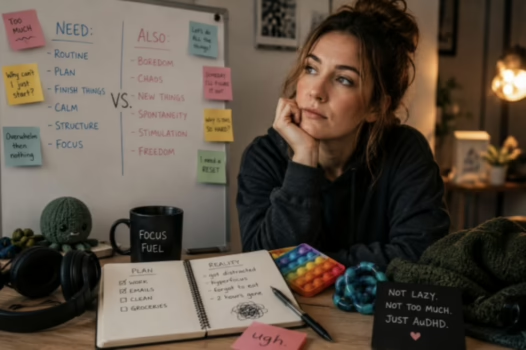
For most of my life, I thought I was just bad at being a person. I could lose myself in a project for nine hours straight and forget to eat, then stare at a sink full of dishes for three days, unable to start. I needed my routine like air, and I was also desperate for something, anything, new. None of it added up, until I finally learned the word that did: AuDHD.
AuDHD is shorthand for being both autistic and having ADHD, in the same brain, at the same time. For decades, clinicians were not even allowed to diagnose the two together, so a lot of us grew up with one label, or none, and a constant sense that the standard explanations never quite fit. If you have always felt like you were running two operating systems that refuse to sync, this might be why.
The Push and Pull
The hardest thing to explain about AuDHD is that it does not feel like autism plus ADHD politely taking turns. It feels like a tug-of-war happening inside one body.
My autistic side craves routine, sameness, and predictability. My ADHD side gets bored with all three within about twenty minutes. One part of me builds a beautiful color-coded system, and the other part abandons it by Wednesday. I can be hypersensitive to a scratchy clothing tag or a flickering light, and also so understimulated that I am chewing my pen and bouncing my leg just to feel something. I want deep focus, and I cannot sit still. I plan obsessively, and I still run late.
This is the part outsiders rarely understand. The traits do not cancel each other out into something average and manageable. They collide, and the collision is exhausting because you are constantly negotiating with yourself.
If that push-and-pull sounds like your daily life, taking a free AuDHD self-assessment can be a low-pressure way to start putting language to it, long before any formal diagnosis. It is not a verdict, just a gentle starting point for understanding how your own brain works.
Common AuDHD Symptoms
When people search for AuDHD symptoms, they usually find dry checklists that miss what it is actually like from the inside. So here is the lived version, the patterns that a lot of other people and I recognize instantly:
- Making a detailed plan for the day, then being physically unable to begin any of it. The gap between knowing and doing feels like a wall.
- Hyperfocusing for hours on something that fascinates you, while basic things like eating, replying to texts, or drinking water quietly fall apart.
- Needing routine to feel safe, then feeling so suffocated by that same routine that you blow it up and start over.
- Sensory overwhelm and sensory seeking at the same time: noise-canceling headphones in one pocket, a fidget toy in the other.
- Social interactions that feel like a performance you rehearsed, leaving you wiped out for hours or even days afterward.
- Emotional reactions, especially to feeling rejected or criticized, hit faster and harder than seems reasonable.
- “Waiting mode,” where a single appointment at 3 p.m. swallows the whole day because you cannot settle into anything else beforehand.
Not everyone has all of these, and having a few does not make you AuDHD. But if the whole picture reads less like a list and more like a description of your inner life, that is worth paying attention to.
Why It Gets Missed, Especially in Women
Here is the part that, honestly, makes me a little angry. So many of us, particularly women and people raised as girls, reach our thirties or forties before anyone connects the dots.
A big reason is masking: the learned, often unconscious habit of studying how other people behave and copying it to seem “normal.” If you spent your childhood watching others closely, mimicking their tone, scripting conversations in advance, and quietly punishing yourself for every social misstep, you may have built a mask so convincing that no teacher, parent, or doctor ever saw the struggle underneath. That is a huge reason AuDHD in women is so badly underdiagnosed. The classic stereotypes were built around hyperactive little boys, not quiet girls who get good grades and then fall apart in private.
It does not help that AuDHD is so easily mistaken for something else. Many of the women I have talked to were told they had anxiety, depression, or were just “too sensitive,” sometimes for years, before anyone thought to ask whether their brain might simply be wired differently. The sheer exhaustion of masking can look exactly like burnout or depression, because in a real sense, that is what it becomes.
Wondering If This Is You?
If you have read this far and felt a slightly uncomfortable flicker of recognition, you are not alone, and you are not making it up.
You do not need a formal diagnosis to start making sense of your own mind, and for many adults that diagnosis can be a long, expensive road. Sometimes the most useful first step is simply giving yourself permission to take the question seriously: to notice the patterns, name them, and stop explaining them away as laziness or oversensitivity. Putting language to something you may have carried silently for years can be a quiet relief in itself.
What Helps Manage AuDHD
The biggest shift for me was not a productivity hack. It was deciding to stop fighting my own brain and start working with it.
That looks different for everyone, but a few things genuinely help. Building routines flexible enough to survive an ADHD week, instead of rigid ones that shatter the moment life changes. Externalize your executive function with timers, lists, and visual reminders, so the planning does not all have to live in your head. Protecting recovery time after socializing, rather than treating the exhaustion as a personal failing. And finding community, online or in person, with people who do not need the tug-of-war explained to them.
A neurodivergence-affirming therapist or assessor can be a real turning point, too. The right professional will not try to make you less autistic or less ADHD. They will help you understand how your particular brain actually works, loosen the shame so many of us carry, and build a life that fits you, instead of one you have to mask your way through.
You are not bad at being a person. You have just been running a brain that nobody ever handed you the manual for. The good news is that the manual exists now, and a lot of us are writing it together.

Hey I'm Olivia and I'm a proud Autistic woman. My special interests are cats, stim toys, and electronic music! I love to write and help other Autistic adults find ways to enjoy life in this LOUD world!