 Alice Turing
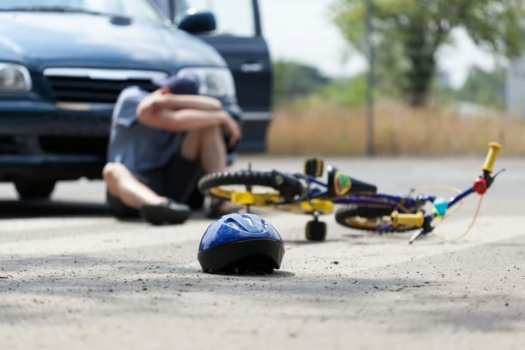
Hackensack is one of northern New Jersey’s busiest cities, serving as the county seat of Bergen County and a major hub for healthcare, business, and transportation. With its mix of residential neighborhoods, shopping areas, hospitals, and commuter traffic, pedestrians regularly share the road with heavy vehicle flow. Busy intersections, school zones, and downtown crosswalks make walking common, but they also increase the risk of serious accidents.
When collisions occur, many injured individuals turn to a Hackensack pedestrian accident lawyer to understand their rights and legal options. Liability in Hackensack pedestrian accidents depends on who acted negligently, drivers, pedestrians, property owners, or even government entities responsible for road safety, and determining fault requires analyzing traffic laws, evidence, and surrounding circumstances.
Understanding how liability works is essential for protecting your right to compensation after an accident.
Why Pedestrian Accidents Happen in Urban Areas
Pedestrian accidents often occur in environments where vehicles and foot traffic intersect frequently. In cities like Hackensack, accidents may happen near the following:
- marked crosswalks
- intersections with heavy turning traffic
- parking lots and commercial entrances
- public transit stops
- poorly lit streets at night
Drivers may fail to yield, speed through intersections, or become distracted by phones or navigation systems. However, liability is not always automatic, and each case requires careful evaluation.
Driver Liability in Pedestrian Accidents
In many cases, drivers bear primary responsibility. New Jersey law requires motorists to exercise reasonable care to avoid hitting pedestrians, especially those using crosswalks or crossing with traffic signals.
A driver may be liable if they
- fail to yield at a crosswalk
- run a red light or stop sign
- drive while distracted or impaired
- exceed posted speed limits
- ignore pedestrian right-of-way rules
Evidence such as traffic camera footage, police reports, and eyewitness testimony often plays a crucial role in proving driver negligence.
When Pedestrians Share Responsibility
Liability does not always fall entirely on the driver. New Jersey follows a comparative negligence system, meaning compensation may be reduced if a pedestrian contributed to the accident.
Examples include:
- crossing outside designated crosswalks (jaywalking)
- ignoring traffic signals
- walking while distracted by a phone
- suddenly entering traffic without warning
Even if a pedestrian is partially at fault, they may still recover damages as long as their responsibility does not exceed the legal threshold.
Third-Party and Government Liability
Some pedestrian accidents involve additional responsible parties beyond the driver.
Property owners or businesses may share liability if unsafe conditions contributed to the crash, such as blocked sidewalks or obstructed visibility near driveways.
Local or state government agencies may also be responsible when roadway design or maintenance issues play a role, including the following:
- malfunctioning traffic signals
- missing crosswalk markings
- poor lighting
- dangerous intersection design
Claims against government entities follow strict notice deadlines, making timely legal action important.
Evidence Used to Prove Liability
Determining liability requires strong supporting evidence. Successful pedestrian accident claims often rely on the following:
- accident reconstruction analysis
- surveillance or dashcam footage
- medical records documenting injuries
- witness statements
- cell phone or toxicology reports
Insurance companies frequently attempt to shift blame onto pedestrians, which is why detailed investigation matters.
Compensation Available After a Pedestrian Accident
When liability is established, injured pedestrians may seek compensation for both financial and personal losses, including the following:
- medical expenses and rehabilitation costs
- lost wages or reduced earning ability
- pain and suffering
- emotional distress
- long-term disability or permanent injury
Because pedestrian injuries are often severe, compensation claims can be substantial and require thorough legal preparation.
Why Legal Guidance Matters
Pedestrian accident cases can become complex quickly, especially when multiple parties dispute fault. Insurance companies often move aggressively to minimize payouts, sometimes arguing that pedestrians were careless or inattentive.
Legal representation helps victims.
- gather and preserve evidence
- Identify all liable parties
- Negotiate with insurers
- meet legal filing deadlines
- pursue fair compensation through litigation if necessary
Understanding liability early helps protect a victim’s financial recovery and long-term well-being.
Key Takeaways
- Liability in Hackensack pedestrian accidents depends on proving negligence.
- Drivers are often responsible, but pedestrians and third parties may share fault.
- Comparative negligence laws allow injured pedestrians to recover compensation even if partially responsible.
- Evidence such as video footage, witness accounts, and accident reports is critical.
- Early legal guidance can help identify liable parties and strengthen a compensation claim.

Follow me down the rabbit hole!
I'm Alice and I live with a dizzying assortment of invisible disabilities, including ADHD and fibromyalgia. I write to raise awareness and end the stigma surrounding mental and chronic illnesses of all kinds.