
 Alice Turing
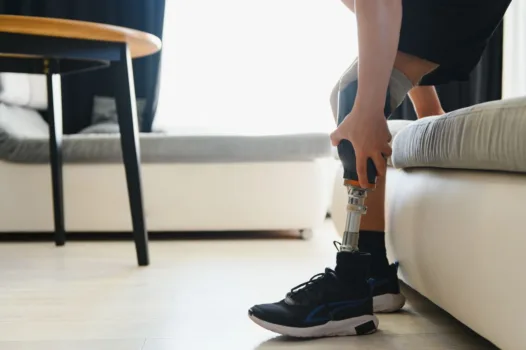
For most people, body hair is a low-stakes problem. You deal with it, or you don’t, and either way, nothing much happens. That calculation changes the moment there’s hardware involved. A prosthetic liner, a wheelchair cushion, an ostomy barrier, an adhesive dressing, or a leg bag strap turns an ordinary patch of skin into a pressure zone, and hair that used to be irrelevant starts causing infections, seal failures, and days when you can’t wear your device at all.
There isn’t much written about this. Prosthetics resources cover socket fit and daily skin checks. Ostomy resources cover leakage and adhesives. Very little of it addresses the hair sitting underneath all of it, or the fact that the default advice, which is to shave, tends to create a second problem stacked on top of the first.
Why hair becomes a problem under pressure
Three things happen when skin gets sealed under a device. Friction drags hairs sideways in their follicles. Occlusion traps heat and sweat with nowhere to go. The trapped moisture then softens the outer layer of skin until it starts to break down. Put those together, and every follicle becomes a small entry point for bacteria.
The scale of this is easy to underestimate. Around three-quarters of lower limb prosthesis users experience dermatologic conditions among prosthesis users, roughly 65 percent more than people without limb loss, with folliculitis among the most frequently reported. That matters more than it sounds, because skin complications are the leading reason people become dissatisfied with a prosthesis, and dissatisfaction is what precedes abandoning it. Hair isn’t a cosmetic footnote in that chain. It sits upstream of whether the device gets worn at all.
The same mechanics show up in other places. A hair caught at the edge of an ostomy wafer breaks the seal and gets pulled out at every change. Hair under a chest strap, a cast liner, or the edge of a long-term dressing does a smaller version of the same thing. Wheelchair users dealing with ingrown hairs on the backs of the thighs and buttocks are contending with the same combination of pressure, shear, and heat, just spread over more hours of the day.
Why shaving often makes it worse
A razor doesn’t only remove hair. It scrapes off part of the stratum corneum along with it, which thins the exact barrier that’s already under assault from your liner or wafer. Then it leaves behind a blunt, stiff, angled hair tip, which is precisely the shape most likely to curl back and re-enter the skin once something presses it flat. That’s how a fix for irritation becomes a source of folliculitis and ingrown hairs within a week.
Timing compounds it. Shaving and then immediately donning a liner puts an occlusive sleeve over freshly abraded skin for the rest of the day. If you shave at all, do it the night before rather than the morning of, and give the skin the overnight window to close up.
Shaving skin you can’t fully feel
If you have reduced or absent sensation in the area, whether from spinal cord injury, diabetic neuropathy, or nerve damage at an amputation site, you can’t use pain as your warning system. That changes the routine. Work in front of a mirror or use your phone camera and inspect visually rather than by feel. Use a fresh single-use blade every time and shave in the direction the hair grows, which is the same guidance wound and ostomy nurses give for peristomal skin. Build a seated station so you’re not balancing while you work, because the fall risk in a wet bathroom is a bigger threat than the hair is. If you don’t already have one, bathroom safety setups that prevent falls are worth sorting out before you add a task that involves a blade and a wet floor.
Hair around a stoma or an adhesive dressing
Peristomal folliculitis has a specific mechanism. A hair escapes the edge of the wafer and drags bacteria backward into the follicle, or the adhesive rips hair out at removal and leaves an open follicle behind. Either way, you get inflamed, tender bumps in the exact ring of skin that has to hold a seal. The inflammation then degrades adhesion, the seal leaks, the leak irritates the skin further, and the cycle keeps going. Mayo Clinic’s peristomal care guidance is direct about the exit from that loop, recommending permanent hair removal for persistent folliculitis when the ostomy is permanent, or the problem keeps recurring.
When permanent reduction is the actual answer
This is the point where lasers stop being a beauty-industry topic and start being a skin-management one. A 2025 study published in the Journal of Clinical and Aesthetic Dermatology followed people with upper and lower limb amputations through laser hair reduction at the residuum. Average Skindex-16 scores fell from 75 out of 117 before treatment to 16 afterward, an overall improvement of about 50 percent. The functioning subscale improved most, at 60 percent, followed by symptoms such as irritation and pain at 54 percent. Every participant was satisfied with the result, and none reported burns or scarring. It’s a small study of four people, so it belongs in the promising column rather than the settled one, but it points the same direction as the earlier work on service members with traumatic lower limb amputations.
It’s worth being clear-eyed about the commitment, because this isn’t one appointment. Hair cycles through active, transitional, and resting phases, and a laser can only destroy a follicle caught in the active phase, which means any single session treats a fraction of what’s actually there. The standard course runs six to eight sessions spaced apart, with a minimum of four weeks between them. Between sessions, you can clip or shave, but waxing, plucking, and epilators are off the table, because pulling the follicle out removes the thing the laser is aiming at.
Skin tone is a device question rather than an eligibility question. An Alexandrite laser is typically used on lighter skin, while a longer-wavelength Nd: YAG is the safer choice for darker skin tones and tanned skin, and some providers combine the two. If a clinic tells you your skin is too dark to treat, that’s a statement about their equipment, not about you, and it’s a reason to ask what wavelengths they actually have. The real limitation is hair color, not skin color. Lasers follow the pigment in the hair shaft, so blond, red, gray, and white hair respond poorly, no matter what device is used.
Getting your care team to take it seriously
Nobody owns this problem. Your prosthetist thinks about sockets, your WOC nurse thinks about barriers, and your dermatologist may never have been told there’s hardware sitting on the skin they’re looking at. You’ll usually have to be the one who connects them, and that means walking in with specifics: how often you’re getting folliculitis, how many days of device use you’ve lost, and what you’ve already tried. Framing it as function rather than appearance also matters for coverage, since most insurers treat hair removal as cosmetic by default. If you’ve run into a wall already, the same tactics that work on dismissive doctors and unresponsive medical systems apply here, and this is a case where documentation does most of the persuading.
A few coordination points are worth raising before anyone points a laser at you. Treatment shouldn’t go over actively infected skin, open wounds, or a recent graft without clearance from the clinician managing it. Scar tissue and grafted areas can respond differently from surrounding skin, so those areas need to be discussed specifically rather than assumed. Treated skin behaves like a mild sunburn for a few days and needs daily SPF 30 or higher for about a month afterward, which is a real consideration if the area normally lives under a liner all day. Ask how the schedule fits around your device use, and plan the first session for a stretch when a few days of tenderness won’t cost you your mobility.
None of this is a promise that removing hair fixes a badly fitting socket or a poorly sited stoma. It doesn’t. But when the hair itself is the thing that keeps restarting the cycle, taking it out of the equation permanently is a reasonable thing to ask about, and the fact that it usually gets filed under cosmetics is a reason it’s been overlooked, not a reason it doesn’t belong in the conversation.

Follow me down the rabbit hole!
I'm Alice and I live with a dizzying assortment of invisible disabilities, including ADHD and fibromyalgia. I write to raise awareness and end the stigma surrounding mental and chronic illnesses of all kinds.