
 Alice Turing
Anyone who relies on a wheelchair cushion, an ankle brace, or a prosthetic socket that actually fits their body knows how much of daily comfort comes down to fractions of an inch. A little extra pressure in the wrong spot can turn into a skin sore, a missed workday, or another trip back to the clinic for adjustments.
For most of the history of orthotics and prosthetics, getting that fit right has meant plaster casts, hand-carved molds, and a wait measured in weeks rather than days. That timeline is starting to shrink, and the shift has less to do with any single flashy invention than with manufacturers finally treating an older 3D printing method as a serious production tool instead of a novelty.
What Selective Laser Sintering Actually Does
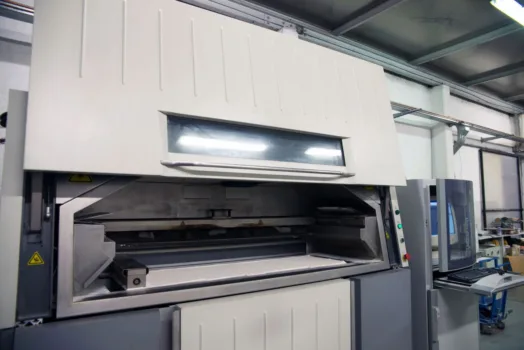
Selective laser sintering, usually shortened to SLS, isn’t new technology. Engineers have used the process since the 1980s. A laser traces across a bed of fine powder, almost always nylon, fusing it layer by layer into a solid shape. What makes SLS especially useful for medical and assistive hardware is that the unfused powder around a part acts as its own support structure during printing, so there’s no need for the removable scaffolding that other 3D printing methods require.
That difference matters more than it sounds, since it means internal ribs, hollow cavities, and curved channels can all be built into a single part without adding cost. Reviews of the technology point to its growing role in producing hip cups, knee trays, and hearing aids, alongside dental restorations, because the process handles complex internal geometry that would be nearly impossible to mold or machine conventionally.
For components that need to flex against skin, grip a joint, or bear repeated weight, nylon’s properties line up well with what a well-fitted device actually needs. It’s tough, mildly flexible, and resistant to abrasion, which is part of why it has become the default SLS material for functional parts rather than purely cosmetic ones.
Why a Precise Fit Isn’t a Luxury
Poor fit is one of the most common reasons people stop using an orthotic or prosthetic altogether. A brace that rubs at the ankle, a socket that shifts weight onto the wrong part of a residual limb, or a seating system that doesn’t match someone’s actual posture doesn’t just cause discomfort. It can lead to pressure sores, joint pain, and eventually abandonment of a device that was supposed to help. Traditional fabrication methods, built around plaster molds and manual carving, leave a lot of room for small errors to creep in between the fitting appointment and the finished device.
Engineering teams at research universities have been experimenting with a same-day custom orthotics process that starts with an optical scan instead of a plaster cast, cutting what used to be a multi-week fabrication cycle down to a single afternoon in some cases. That kind of turnaround matters most for people who need frequent adjustments as their bodies change, including children with cerebral palsy and adults recovering from strokes, since more than two-thirds of the roughly 700,000 people who have a stroke in the U.S. each year go on to need long-term rehabilitation that often includes ankle-foot orthotics.
From Prosthetic Sockets to Wheelchair Seating
Assistive devices have quietly relied on individualized manufacturing for longer than most people realize. Prosthetists have long paired traditional materials with direct socket prosthetic designs that shape the interface between limb and device around a specific patient’s residual limb, rather than forcing the limb to adapt to a generic shape. The same logic drives complex rehab power wheelchairs, which are built around a user’s specific seating, tilt, and pressure-relief needs rather than sold as one-size-fits-most equipment.
What SLS adds to that existing philosophy of customization is speed and geometric freedom. A socket or a seating component that once required a mold, a cast, and days of hand-finishing can now go from digital scan to finished part without any of those intermediate steps, and without sacrificing the kind of complex internal shaping that makes a device comfortable rather than merely functional.
How Engineering Teams Are Applying SLS to Structural Parts
The shift isn’t limited to devices that touch the body directly. Biomedical engineering teams building diagnostic and monitoring instruments are also using SLS to replace conventional mechanical hardware. Instead of buying a linear rail assembly made of precision-ground steel rails and a bearing-loaded carriage, some teams are now printing bearing surfaces directly into structural parts, then pairing the printed piece with a simple ground rod to create the sliding motion an instrument needs.
According to one engineering team’s own account of the approach, complex parts that would have run close to a thousand dollars each to machine came in at around a tenth of that cost when produced this way, with bearing surfaces printed into structural parts replacing what used to be entire linear-rail subassemblies, and with lead times measured in days rather than the roughly five weeks that machined plastic parts typically require. That kind of compression doesn’t just save money on a single prototype. It changes how many design iterations a team can afford to run before locking in a final version, which has a direct bearing on how well the finished device fits the people who will eventually use it.
What to Ask If You’re Being Fitted for a New Device
If you’re due for a new orthotic, prosthetic, or wheelchair seating system, it’s worth asking your provider directly whether digital scanning and 3D printing are part of their process, since availability still varies a lot by clinic and by insurance plan. A few questions can help clarify what you’re actually being offered:
- Whether the device will be based on a digital scan or a traditional plaster cast
- How many fitting appointments the process is expected to take
- Whether adjustments after the first fitting require a full remake or just a reprint
- What material the device will be made from, and whether it’s rated for your activity level
None of this guarantees a shorter wait or a better result, since clinic capacity and insurance approval timelines still shape most of the process. But knowing the right questions to ask puts you in a better position to advocate for the option that actually fits your life, not just the standard workflow a clinic defaults to.
What This Could Mean Going Forward
None of this makes custom-printed devices a universal fix. Nylon parts can warp if they’re wide and flat, since the material absorbs moisture and holds internal stress from the printing process, and enclosed voids in a design can trap unfused powder that’s difficult to remove afterward. Those limitations rule out some geometries and mean SLS won’t replace every fabrication method used in orthotics and prosthetics.
What it does change is the economics of building something truly custom. When the cost and turnaround time for a one-off, precisely fitted part drop this far, more parts of the assistive device world become candidates for individualization instead of standardization. For a community that has spent decades adapting itself to equipment that wasn’t quite built for any one body, that shift is worth watching closely, even if it arrives quietly, one printed part at a time.

Follow me down the rabbit hole!
I'm Alice and I live with a dizzying assortment of invisible disabilities, including ADHD and fibromyalgia. I write to raise awareness and end the stigma surrounding mental and chronic illnesses of all kinds.