 Alice Turing
Getting older is supposed to come with experience. Wisdom. A sense of knowing yourself. But for many people living with disabilities, aging adds another layer, one that often goes unseen, even in conversations about accessibility and inclusion.
It’s not just about wheelchairs or ramps. It’s about how the world changes around a person whose body, mind, or needs already sit outside the “default” that society quietly designs for. Aging with a disability isn’t a niche topic. It’s a universal one, because if we live long enough, most of us will experience some form of it.
Why Disability Looks Different with Age
Disability doesn’t vanish with retirement. It evolves. For many, the challenges of aging amplify existing barriers. Joints stiffen, energy wanes, medications multiply, and the systems meant to support independence grow more complex.
But the most difficult part isn’t always physical. It’s the gradual erosion of autonomy, the way small losses add up until even routine tasks become dependent on someone else’s schedule.
Accessibility experts talk about “universal design,” but few spaces are truly built for a lifetime of change. An environment that once worked for a younger adult using adaptive tools might suddenly feel restrictive decades later. The irony is that the design solutions already exist (wider doorways, reachable counters, voice-assisted technology) they just aren’t prioritized.
The Emotional Weight of Overlooking Accessibility
When accessibility fades into an afterthought, it sends an unspoken message: independence has an expiration date.
For many older adults with disabilities, this can create quiet grief, not over aging itself, but over being slowly designed out of the world. It’s subtle things: a new condo without automatic doors, a grocery aisle too narrow for a mobility device, a care program that assumes cognitive decline where none exists.
Aging is not the enemy. Inaccessibility is. That distinction matters, because emotional well-being and physical independence are closely linked. Seniors who feel excluded or helpless are more likely to experience depression, anxiety, and cognitive decline. The environment shapes the person. When it’s inclusive, people thrive longer.
When Disability Isn’t the Primary Diagnosis Anymore
Another overlooked reality: as people with disabilities age, their healthcare focus often shifts. What was once a stable condition (spinal injury, cerebral palsy, multiple sclerosis) now intersects with age-related illnesses like arthritis, heart disease, or dementia.
This overlap can blur care priorities. Doctors may treat the “aging” symptoms while overlooking long-standing needs tied to disability. Families and caregivers can struggle to advocate effectively when every appointment feels like triage.
That’s where integrated care models come in, the kind that see a person as a whole, not as a collection of diagnoses. It’s not revolutionary. It’s just rare.
The Hidden Labor of Staying Independent
Independence, for people aging with a disability, often looks like work. The kind that’s invisible to outsiders, hours spent coordinating transportation, adjusting medication schedules, or troubleshooting adaptive devices that no longer fit quite right.
Many seniors quietly exhaust themselves trying to maintain routines that used to come easily. When systems fail, it isn’t a matter of inconvenience. It’s safety, dignity, and self-worth.
That’s why supportive communities matter. Not the kind that take over, but the kind that listen.
Creating Environments That Age Gracefully Too
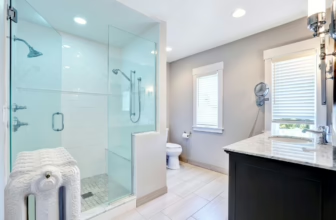
Places built with accessibility at their core don’t just serve people with disabilities, they serve everyone better. The slope that helps a wheelchair also helps a stroller. The grab bar that prevents a fall for one person can prevent a lifetime of injury for another.
At All Seniors Care Living Centres, accessibility isn’t treated as an add-on. Their residences integrate design features that allow seniors to remain active and self-sufficient, whether they use mobility aids, have sensory impairments, or live with mild cognitive decline.
What’s most telling isn’t the architecture itself, but the philosophy behind it: independence doesn’t end at a certain age. It just takes new forms.
Technology, Accessibility, and the Modern Aging Experience
Technology has become an unlikely equalizer in senior care, if used correctly.
Smart-home systems can automate lighting, temperature, and security for people with mobility or vision challenges. Voice-controlled devices reduce the need to reach or bend. Even simple tablet interfaces can reconnect isolated seniors with family and healthcare providers.
But accessibility isn’t just about adding gadgets. It’s about designing technology that considers tremors, hearing loss, cognitive fatigue, and visual contrast. What good is an app if the buttons are too small or the audio cues too soft to hear?
Developers often test for usability, but rarely for lived experience. That’s the next frontier: tech that ages well alongside its users.
The Economic Blind Spot in Disability and Aging
Accessibility isn’t just ethical. It’s economical. Studies consistently show that accessible environments reduce long-term healthcare costs. Fewer falls, fewer hospitalizations, and more independence mean fewer care hours and higher quality of life. Yet, government funding and infrastructure planning still treat accessibility as a specialized expense rather than a baseline expectation.
As a result, many older adults are forced into care settings earlier than necessary, not because they need medical attention, but because their homes stopped working for them.
The fix isn’t more institutions. It’s smarter design at every level: public housing, transportation, healthcare, and community planning.
What Real Accessibility Looks Like
True accessibility isn’t a checklist. It’s empathy in action.
It looks like a dining space where hearing aids don’t pick up constant background noise.
It looks like signage in high-contrast fonts that can be read without strain.
It looks like wide hallways, secure flooring, adjustable furniture, and lighting that honors the body’s natural rhythm.
It also looks like patience. Like staff trained not just in safety procedures, but in emotional intelligence, people who know when to offer help and when to step back.
Communities that get this right create something rare: places where aging and disability aren’t treated as limitations, but as part of life’s continuity.
The Intersection of Disability, Identity, and Dignity
Disability is part of identity. Aging doesn’t erase it. Yet too often, care systems treat older adults with disabilities as fragile rather than capable.
This shift in perception can strip away the sense of self people spent decades building. It’s not about vanity or ego. It’s about dignity, the feeling of being seen as a whole person, still able to contribute, still deserving of privacy and agency.
That’s why conversations about aging need to include disability voices from the start. People who have navigated accessibility challenges their whole lives know what works. They’ve been designing their own solutions long before institutions caught up.
Building a Future That Includes Everyone
Aging with a disability doesn’t have to mean shrinking your world. It can mean reshaping it.
The challenge isn’t that bodies change. It’s that society still hasn’t learned how to change with them.
If we begin designing communities (from healthcare systems to retirement residences) around inclusivity instead of convenience, we create something better for everyone.
The goal isn’t perfection. It’s progress. And progress starts with noticing what we’ve been overlooking all along.

Follow me down the rabbit hole!
I'm Alice and I live with a dizzying assortment of invisible disabilities, including ADHD and fibromyalgia. I write to raise awareness and end the stigma surrounding mental and chronic illnesses of all kinds.