
 Karin Willison, MA
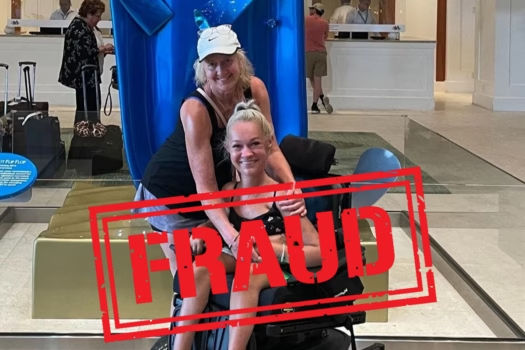
On November 6, 2026, Alexandria Dzimitowicz, aka Alex Dacy, aka Wheelchair Rapunzel, and her mother Jackie were charged with felony Medicaid fraud in the state of Illinois.
Illinois Attorney General Announces Charges Against Alex and Her Mother
Here are the relevant excerpts from a press release issued by the Illinois Attorney General’s office:
Chicago – Attorney General Kwame Raoul today announced charges against three individuals for allegedly defrauding the state out of thousands in Medicaid funds.
The Attorney General’s office charged Alexandria Dzimitowicz, 32, and Jacqueline Dzimitowicz, 62, both of Palos Heights, Illinois, in Cook County Circuit Court with one count of vendor fraud, a Class 1 felony punishable by up to 15 years in prison; two counts of theft, Class 1 felonies each punishable by up to 15 years in prison; and one count of forgery, a Class 3 felony punishable by up to five years in prison. Their next court dates are scheduled for Dec. 16.
…
According to Raoul’s office, between November 2021 and February 2025, Jacqueline Dzimitowicz submitted false Medicaid claims to the Illinois Department of Healthcare and Family Services (HFS) for personal assistant services that she did not provide to her daughter, Alexandria. Raoul’s office alleges Alexandria did not reside with her mother and later lived in Florida while Jacqueline submitted claims for services. Approximately $44,856 is alleged to have been stolen through these actions.
Analyzing the Public Evidence Against Wheelchair Rapunzel
As with any persons charged with crimes, Alex and Jackie are innocent until proven guilty. However, Alex’s social media and public court records prove that she was living in Florida for four years while continuing to receive Illinois Medicaid waiver services.
She gave birth to her child in Florida.
She lived with her baby’s father and his parents in Florida.
She has an open child custody dispute filed against her in Florida because she won’t allow her daughter’s father any interaction or visitation.
After she and her daughter’s father broke up, she rented an apartment in Florida, where in April, 2025, she coerced a 13-year-old boy she had never met before into undressing her, bathing her, and attempting to buy her beer.
She only returned to Illinois after the police began investigating her conduct with the 13-year-old, for which she was charged with lewd and lascivious conduct on a child under 16 years, a second-degree felony. She ultimately pled guilty to a misdemeanor charge, contributing to the delinquency or dependency of a minor, and was sentenced to a year of probation.
She spent years living in Florida (and committed crimes against a child in Florida) without switching her residency and Medicaid to Florida.
She attempted to justify having a minor, a total stranger, undress her and put her naked body in the bathtub, with the excuse that she couldn’t afford a caregiver. She told the police she “made too much money” to qualify for Medicaid home care, but that was a lie, because she was receiving home care funding from Illinois. Where was that money going?
Care Without Conditions = Crime Without Consequences
Shockingly, Alex has decided to essentially admit to the fraud, once again attempting to justify her behavior by saying the system is unfair. She says she is starting a movement called “Care Without Conditions” to raise awareness about how complicated and limiting Medicaid services can be.
All I can say is you’re late to the party, Girlypoop. The disability community has been fighting to fix these programs for years. You were just too busy getting drunk, neglecting your child, grifting the public with questionable fundraisers, and getting naked with a teen boy to notice.
Alex’s “movement” is a perfect example of that classic ClickHole meme, The Worst Person You Know Just Made a Great Point. It’s the right message being delivered by someone with absolutely no business doing so.

But since Alex is drawing attention to Medicaid home and community-based services, albeit in a way that deeply harms people who need them, let’s talk about them. Most people don’t know anything about HCBS — here’s your chance to become someone who does.
Understanding Medicaid Home and Community-Based Services
In the United States, Medicaid is a federally and state-funded program that provides healthcare primarily to low-income people. Most importantly to our conversation, it is the only form of health insurance or healthcare that provides long-term care, i.e., nursing home or home care services to people with disabilities or seniors. This means that a person with a disability who needs help dressing and bathing can’t get a health plan through the Marketplace or through a job that would cover those needs. Medicaid is the only option.
Medicaid has significant income and resource restrictions that vary by state, but generally require that recipients be very poor and have limited funds. There are ways to keep Medicaid while working if you have a disability and need home care, but we’ll get back to that later.
Home care services are separate from basic Medicaid and typically provided via a Medicaid waiver. A Medicaid waiver is a special agreement between the federal government and a state allowing them to alter (“waive”) certain aspects of Medicaid regulations. Unfortunately, Medicaid at the federal level continues to have an institutional bias, meaning every state’s Medicaid is required to cover nursing home care but not in-home care. To cover in-home care using federal Medicaid funds, states must create a home and community-based services waiver program. HCBS waivers can provide personal care attendants, home nursing, job coaches, and more.
States have considerable flexibility in designing these programs, which means the amount of support you can get — and if you can get care at all — varies widely by state. More on that later, but here’s a state-by-state guide to Medicaid waivers if you want to learn more about programs in your area, and a guide to getting personal care attendant services (legally!).
Access to home and community-based services is a legal right. In 1999, the Supreme Court ruled in Olmstead v. L.C. that unjustified segregation of people with disabilities in institutions such as nursing homes and psychiatric hospitals constitutes discrimination and violates the Americans with Disabilities Act. Therefore, a person who wishes to receive services in their home and community rather than an institution has the right to do so, provided those services can be reasonably accommodated by the state.
Studies have shown that providing care in a person’s home is less expensive than placing them in a nursing home or other facility, so in theory, people with disabilities should always be able to live in the community. In practice, waiver programs range from excellent to underfunded, limited, hard to access, and everything in between.
Why People with Disabilities Need Self-Directed Home Care Services
Many people without much experience with disability think that people with disabilities get caregivers through an agency. That does happen sometimes, but most disabled people despise agencies. They tend to provide poorly trained, low-skilled workers who are not reliable. They keep a large portion of funds as profits and don’t pay their workers fairly. Agencies often don’t provide consistent care; they may send a different worker to a person’s home every shift, or may not have someone available at all. Nobody wants to have a different stranger bathing them every single day!
Medicaid self-directed or consumer-directed programs allow people with disabilities to choose and manage their own personal care attendants. Currently, over 1.5 million Americans with disabilities use self-directed services. Workers clock in and out online or by phone, or submit timesheets to a state portal every two weeks, which are then approved by the disabled person or their representative. The disabled person can hire family members, friends, or people from the community. They can train those individuals to address their specific needs and build a relationship of trust and respect. If a caregiver is abusive or unreliable, they can fire them and hire somebody else.
Self-directed programs are essential for people with disabilities to live fulfilling lives. We have the right to choose who cares for us. Alex has frequently been criticized for “finding caregivers on Craigslist” — but that’s actually a fairly common and reasonable way to advertise for personal care aides. It’s true that she doesn’t seem to choose responsible people, but she also shouldn’t be expected to hire a nurse in scrubs who treats her like nothing more than a patient. Most people with disabilities prefer a PCA who shares their interests and with whom they can forge a positive connection.
Fraud in HCBS Programs
Despite Alex’s very public misbehavior, fraud is rare in these programs. To get approved, you must have a significant disability that would otherwise require care in a nursing home or other care facility, and need help with activities of daily living such as dressing and bathing. Hours are determined based on level of need. In this case, Alex undoubtedly needs caregivers — possibly 24-hour care, certainly at least 18 hours per day. The fraud occurred when she became a Florida resident but continued to claim Illinois waiver funds. She didn’t apply for care in Florida when she moved there, as she should have.
State HCBS Programs and Waiting Lists
As previously outlined, Medicaid waivers differ substantially by state, as do their funding levels. As you might expect, blue states typically have better home care programs, though there’s still quite a bit of variation. What can undoubtedly be said is that the worst states for home care are (or were until recently) highly Republican controlled: Mississippi, Texas, and Florida.
While this doesn’t justify Alex’s actions, Florida has one of the worst home care programs in the country. As of November 2026, over 20,000 people remain on waiting lists for HCBS in Florida. This is a clear violation of Olmstead and the right to community living. No one should ever have to wait for these services. With that said, the program has a ranking system that prioritizes applicants based on need. People like Alex who have substantial care needs will be placed at the top of the list.
Alex would certainly not have waited four years, the amount of time she remained enrolled in Illinois HCBS, to receive home care in Florida. If she had been put on a waiting list, she could have used her large following to bring enough attention to her case to get services faster and raise awareness of this issue. THAT would have been an appropriate use of her platform.
Alexandria Dzimitowicz Does Not ‘Make Too Much Money’ for Medicaid Home Care
Alex has claimed that she makes too much money to qualify for Medicaid services. Given that Medicaid is usually associated with poverty, it’s an easy claim to believe, but it’s probably not true. First of all, the fact that she was indicted for Medicaid fraud proves that she was receiving funding for home care in Illinois with her income.
Second, both Illinois and Florida have Working Disabled Medicaid programs that allow employed people with disabilities to keep their services. These programs, which exist in most states, recognize that people with severe disabilities want to work, but would never earn enough to pay thousands of dollars per month out-of-pocket for care on top of living expenses.
The monthly income limit for the Illinois program as of 2026 is $4393; in Florida, it’s $5467. That means if Alex had not committed Medicaid fraud and had switched her services to Florida, she could have earned over $1000 MORE per month without losing home care.
Do we really believe Alex was making over $5000 per month selling herself on OF, or with her current art business? It seems highly unlikely.
Working disabled programs have problems and limitations. Spousal income is considered “unearned,” so people can’t get married without losing care. They limit opportunities by having a flat cutoff that doesn’t reflect the cost of the person’s care plus their living expenses. Imagine getting a raise from $5400 to $6000 per month and losing $16,000 per month in home care services as a result. And yes, that’s a realistic monthly cost for someone with Alex’s needs. Many disabled people have to work part-time or turn down raises to avoid losing home care and other services. We are punished for working, for succeeding in a system that is set up for failure. Still, these programs represent the only feasible path out of extreme poverty for many disabled people.
Moving Between States and the Reality of Being Disabled in America
Due to the state-based nature of Medicaid HCBS, moving is hard when you have a severe disability. It means going through the process of applying for services all over again, and facing a gap in care. It means navigating a new program with different rules, and potentially being waitlisted, denied, or receiving too few hours of care and having to appeal.
I experienced this nightmare firsthand when I was forced to move for my safety after surviving a home invasion robbery perpetrated by a former caregiver. It took six months to get services in my new state. My family had to pay thousands of dollars out-of-pocket for my care during that time — a huge financial burden and a cost most people with disabilities could not afford at all. But we had no choice, because my life was in danger. Alex just wanted to party with her drug-addicted boyfriend and have a baby neither of them were mature enough to raise.
To be clear, people with disabilities should have the right to move freely at any time for any reason. The current system is unjust and needs to be fixed. However, the reality of being disabled in America right now is that we have to plan ahead and choose wisely if we want to move. We have to protect ourselves because we will die without home care — and that means moving states only when we are fully prepared and have the support system to do so.
Real Solutions to Fix Medicaid HCBS
Alex’s Care Without Conditions “movement” makes a mockery of the disabled activists and organizations who have been fighting to fix healthcare and Medicaid for decades. Her behavior endangers all the decent, non-predatory people with disabilities who need services and now fear that we will be scrutinized and treated as potential fraudsters. And it’s coming at the worst possible time, when the Trump Administration’s Medicaid cuts and attacks on Olmstead already threaten our safety and independence.
Universal health care in the United States would be life-changing for people with disabilities. If you care about people with disabilities, you should support universal health care. Medicare and Medicaid should be available to anyone who wants them, not just poor people, and funded through taxes or income-based premiums.
Eligibility for personal care aide services should be based on medical need, not income or assets. People with disabilities should be rewarded for working, not punished. We should not be trapped in poverty, prevented from getting married, or forced to navigate complex working disabled programs, ABLE accounts, and other workarounds just to use the toilet. People who earn more money should simply pay higher taxes, without fear of losing thousands of dollars a month in care.
Advocates don’t need to be perfect. But we should all agree that a child predator who commits fraud has no business representing the disability community.
Here are a few legitimate organizations that advocate for Medicaid reform and the independence of people with disabilities. They deserve your time and financial support, not Alex’s scam.
National Council on Independent Living — Advocates for the rights and services that help people with disabilities thrive in their homes and communities
Little Lobbyists –Family-led organization that lobbies for robust disability services for kids
Caring Across Generations — Fights for robust Medicaid services and against cuts
The Arc — Supports rights and provides services for people with intellectual and developmental disabilities
Disability Rights Education and Defense Fund — DREDF advances the civil and human rights of people with disabilities through legal advocacy, training, education, and public policy and legislative development.
Where to Talk About Wheelchair Rapunzel
Reddit is the most popular spot for discussing her latest antics!
Alex Dacy Subreddit
Wheelchair Rapunzel Subreddit

Founder and Editor-in-Chief of The Ability Toolbox. I received my BA in English from Stanford University and MA in Clinical Psychology from Antioch University Los Angeles, and have worked in entertainment and health media for over 20 years. I also blog about traveling with a disability. As a wheelchair user with cerebral palsy, I am deeply committed to amplifying the voices of the disability community through writing and advocacy.